
Heels Lifting in the Squat: Why It Happens and How to Fix It
7 min read
If your heels peel off the floor as you sit into a squat, your weight tips onto your toes just when you need a stable base. It's common, it's usually fixable, and the cause is rarely a mystery: most of the time it's your ankles, where your weight sits over your feet, or your stance. Here's how to tell which, the fixes that match each cause, and what FormLens can — and can't — tell you about it.
What heels lifting looks like
Your heels come up as you descend or at the very bottom, and you finish the rep on the balls of your feet — often with your knees shooting forward or the bar drifting in front of your mid-foot. Some lifters only see it on the last reps of a hard set, others on every rep, and that difference is a clue to the cause.
Two different problems look alike here. A heel that lifts because your ankles have run out of bend is a mobility problem. A heel that lifts because your weight rolled onto your toes is a balance problem, even with plenty of ankle range. The fixes differ, so find out which you have first.
Heels down
Whole foot on the floor, weight over the middle of the foot.
Heels up
The heel peels off the floor and your weight tips onto your toes.
Does it matter?
A lifted heel shrinks your base to the front of your foot. Under a bar, that makes balance harder, pushes the bar forward of your mid-foot, and your body finds the range your ankles won't give somewhere else. In a lab study, restricting how far the ankle could bend during a squat increased knee valgus and inward knee movement (Macrum 2012 (opens in a new tab)).
Ankle range and squat depth go together, too. In 101 healthy adults, ankle dorsiflexion — how far your knee can travel forward over your foot — was among the measures most closely linked to how deep people could squat (Kim 2015 (opens in a new tab)). And in a motion-capture study of 11 men squatting at about 75% of their maximum, those with more ankle mobility kept a more upright torso at parallel (Fuglsang 2017 (opens in a new tab)).
None of that makes a lifted heel an injury on its own. It's a sign that something upstream — ankles, balance, stance or load — needs attention.
Why it happens
- Ankle mobility. To squat deep with your heels down, your shins have to lean forward over your feet. If your ankles run out of bend first, the heel is the next thing to give.
- Weight on your toes. Starting the squat by driving your knees forward, instead of sitting down between your hips and heels, rolls your weight forward. The heel comes up even with plenty of ankle range.
- Stance. A narrow stance with your toes pointing straight ahead asks the most of your ankles. A little wider, with the toes turned out, usually asks less.
- Depth. Going deeper than your ankles allow today — the heels lift in the last few centimetres.
- Load and fatigue. A weight you can't control at the bottom, or the last reps of a hard set, tip you forward.
- Footwear. Soft, squashy running shoes let your foot rock and sink; a flat, firm sole gives you a stable base.
Self-test: find your cause
Film each test from the side at hip height — the easiest angle for seeing your heels by eye.
- Knee-to-wall test. Face a wall with your foot a few centimetres away and drive your knee forward to touch it without the heel lifting. Move the foot back until you can only just touch, and measure from your big toe to the wall. It's a reliable test (Bennell 1998 (opens in a new tab)): a short distance, or a big difference between sides, points to your ankles.
- Heels raised. Squat to your usual depth with 1–2 cm plates under your heels. If your heels stay put and the squat suddenly feels easy, your ankles are the main limiter.
- Goblet squat. Hold a dumbbell at your chest and squat. The weight in front makes it easier to sit down between your heels. If your heels stay down here but lift under a barbell, look at balance and bracing first.
- Tripod check. Squat slowly with no weight, feeling your big toe, little toe and heel on the floor the whole way. If the weight runs to your toes before the heels lift, it's balance, not range.
- Stance change. Widen your stance a little and turn your toes out 15–30°. If the heels settle, stance was part of it.
How to fix it
Match the fix to the cause you found, and change one thing at a time so you know what worked.
- Ankles: knee-to-wall rocks and calf stretches — with the knee straight and bent — most days. Re-test weekly: on the wall test, a change of about 1.5 cm or more is bigger than measurement noise (Konor 2012 (opens in a new tab)).
- A raised heel while you work on it: plates or a wedge under your heels, or weightlifting shoes. Lifting shoes reduced how far the ankle had to bend (Legg 2017 (opens in a new tab)) and how far the trunk leaned forward (Sato 2012 (opens in a new tab)), and a 2.5 cm heel block reduced forward lean at the bottom of the squat (Charlton 2017 (opens in a new tab)). They didn't bring lifters' thighs any closer to horizontal (Sato 2012 (opens in a new tab)), so treat them as a tool for position, not a shortcut to depth — many lifters squat in them for good.
- Balance: cue “sit down between your heels” and keep a tripod foot — big toe, little toe and heel down. Goblet squats and pause squats teach the bottom position.
- Stance: use the stance and toe angle from your self-test, and let your knees follow your toes.
- Depth and load: squat to the depth where your heels stay down — a box at that height helps — and drop 10–20% of the weight while you rebuild. Lower the box as your ankles improve.
Don't fix it by leaning forward
Folding your chest down can keep your heels on the floor, but it moves the problem to your hips and back. The goal is heels down with the same brace and depth — see squat depth explained for what limits depth, and how to fix knees caving in if your knees drift inward too.
Checking it with FormLens
For the app, film front-on at hip height with your whole body and feet in frame — the angle FormLens asks for squats (how to film your lifts). FormLens checks around the bottom of each filmed rep for an obvious heel lift, and when it catches one, the Squat Mechanics card on the results screen says how many reps it happened on — for example, “Heel lift detected in 2 of 5 reps”.
The check is deliberately blunt. It compares the heel and toe points of one foot, and only a heel that comes clearly off the floor counts, so no note doesn't prove your heels stayed flat. Replay the clip with the skeleton overlay and watch the heel and toe points at the bottom of each rep — or add a side-on set for the clearest view by eye.
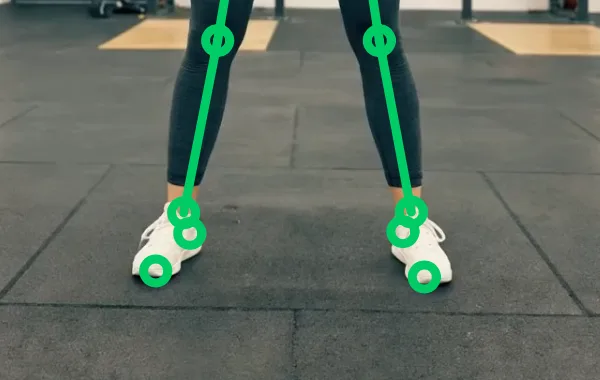
The same clip gives you your depth on every filmed rep, the difference between your left and right knee angles, and your stance width as a multiple of your shoulder width. Heel lift, depth and left/right balance tend to move together, so read them side by side — they also feed your form score. Knee tracking isn't measured yet, so check that on the replay (see how to fix knees caving in).
Heels-down checklist
- Tripod foot: big toe, little toe and heel down
- Weight over the middle of your foot, bottom to top
- Knees travel forward and out over your toes
- A depth you can reach with your heels down
- Firm, flat shoes — or lifting shoes
- Ankle work most days, re-tested weekly
How FormLens measures this
Squat · Filmed front-on, phone at hip height
- Depth
- Your lowest knee angle on each rep. Under 90° counts as reaching depth; the set is flagged when most reps stop short.
- Left/right balance
- The difference between your left and right knee angles at the bottom. 10° or more flags a rep.
- Heel lift
- Checks the bottom of each rep for an obvious heel lift, read from one foot, and shows how many reps it caught. Small rises aren't flagged.
- Stance
- Stance width (as a multiple of your shoulder width) and foot flare (toe-out), read from your setup.
- Consistency and tempo
- How closely your reps match each other, and how steady your rhythm is, on multi-rep sets.
Heel lift is a blunt check on purpose: it compares the heel and toe points of one foot around the bottom of each rep, and only a heel that comes clearly off the floor counts. A small rise, or a lift on the other foot only, can pass without a note — replay the clip to check.
Not auto-flagged yet: knee cave, butt wink and back angle. Front-on, depth reads conservatively — the knee angle can read higher than it really is. Every measurement is an estimate from a single camera, so setup matters — see the camera setup.
FAQ
Is it bad if my heels lift when I squat?
It isn't an injury in itself, but it shrinks your base to the front of your feet and usually means your ankles, balance or load need work. If it only happens on the last rep of a hard set, lighten the load a little.
Should I squat with plates under my heels?
Yes, as a tool: a small heel raise reduces how far your ankles need to bend. Keep working on your ankles alongside it.
Do weightlifting shoes help?
They let you squat with less ankle bend and a more upright torso (Legg 2017 (opens in a new tab); Sato 2012 (opens in a new tab)), which is why so many lifters use them. They won't fix a balance problem, and they don't automatically add depth (Sato 2012 (opens in a new tab)).
Why do my heels only lift on heavy sets?
Usually load or fatigue: the weight tips you forward at the bottom. Drop 10–20%, own the bottom position with your heels down, and build back up.
Does FormLens detect heel lift?
Yes — an obvious one. It checks around the bottom of each filmed rep, front-on, and tells you on how many reps it caught a lift. Small rises aren't flagged, and it reads one foot, so replay the clip to check the other side.
When should I see a professional?
If your ankle, knee or Achilles hurts when you squat, or one ankle is far stiffer than the other after an old injury, see a physio. This guide is about technique, not injuries.
Sources
- Macrum E, Bell DR, Boling M, Lewek M, Padua D. Effect of limiting ankle-dorsiflexion range of motion on lower extremity kinematics and muscle-activation patterns during a squat. J Sport Rehabil. 2012;21(2):144–150. View study (opens in a new tab)
- Kim SH, Kwon OY, Park KN, Jeon IC, Weon JH. Lower extremity strength and the range of motion in relation to squat depth. J Hum Kinet. 2015;45:59–69. View study (opens in a new tab)
- Fuglsang EI, Telling AS, Sørensen H. Effect of ankle mobility and segment ratios on trunk lean in the barbell back squat. J Strength Cond Res. 2017;31(11):3024–3033. View study (opens in a new tab)
- Bennell KL, Talbot RC, Wajswelner H, Techovanich W, Kelly DH, Hall AJ. Intra-rater and inter-rater reliability of a weight-bearing lunge measure of ankle dorsiflexion. Aust J Physiother. 1998;44(3):175–180. View study (opens in a new tab)
- Konor MM, Morton S, Eckerson JM, Grindstaff TL. Reliability of three measures of ankle dorsiflexion range of motion. Int J Sports Phys Ther. 2012;7(3):279–287. View study (opens in a new tab)
- Legg HS, Glaister M, Cleather DJ, Goodwin JE. The effect of weightlifting shoes on the kinetics and kinematics of the back squat. J Sports Sci. 2017;35(5):508–515. View study (opens in a new tab)
- Charlton JM, Hammond CA, Cochrane CK, Hatfield GL, Hunt MA. The effects of a heel wedge on hip, pelvis and trunk biomechanics during squatting in resistance trained individuals. J Strength Cond Res. 2017;31(6):1678–1687. View study (opens in a new tab)
- Sato K, Fortenbaugh D, Hydock DS. Kinematic changes using weightlifting shoes on barbell back squat. J Strength Cond Res. 2012;26(1):28–33. View study (opens in a new tab)
Educational only — not medical advice. FormLens is a training aid, not a medical device; measurements are estimates from a single camera. If something hurts, see a physio or doctor. Terms of Use
First published · Last updated · By FormLens